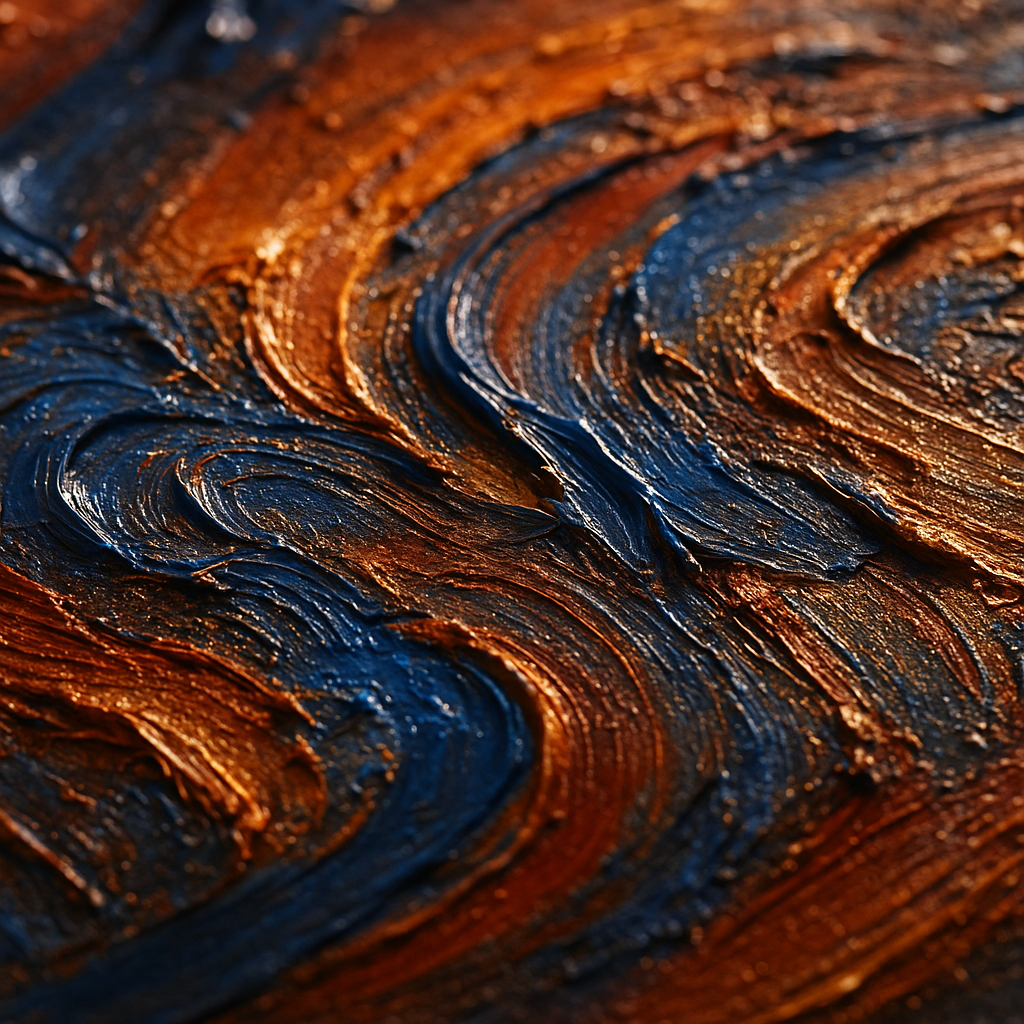
There’s a moment when you stand in front of an abstract painting and feel something shift. Not because you “understand” it — abstract art rarely demands that — but because something about the surface pulls you in. Your eyes trace ridges of paint, smooth expanses, rough patches that catch the light differently. That sensation? That’s texture doing its quiet, powerful work.
Texture in abstract art is more than a physical quality. It’s a language. It communicates emotion, intention, and energy in ways that color and form alone simply can’t. And for anyone who makes or loves abstract art, understanding why texture matters so deeply is a genuine game-changer — whether you’re picking up a palette knife for the first time or trying to figure out why a particular painting stops you in your tracks.
What Is Texture in Abstract Art, Really?
Before diving into technique and philosophy, it’s worth clarifying what we actually mean when we talk about texture in art. There are two distinct types, and they work very differently:
- Actual (tactile) texture — This is physical, three-dimensional texture you could genuinely feel if you ran your fingers across the surface. Think thick impasto paint, embedded sand, torn paper, or layers of collage.
- Simulated (visual) texture — This is the illusion of texture created through technique. An artist might use brushwork or mark-making to suggest roughness or depth on what is actually a flat surface.
In abstract art specifically, both types are used with tremendous intention. Because abstract work isn’t anchored to recognizable subjects, texture often becomes one of the primary carriers of meaning. When there’s no tree or face to look at, the surface itself becomes the subject.
Abstract texture in art refers to surface quality — real or implied — that evokes feeling and response without necessarily representing anything from the physical world. A thick diagonal scrape of paint isn’t a cliff face, but it might feel like one. That tension between what something is and what it feels like is exactly where abstract art lives.
The Role of Texture in Art: Why It Matters
Ask any painter what texture does in a piece and you’ll get a different answer depending on who you ask. That’s part of its richness. But broadly speaking, texture in abstract art serves several interconnected purposes:
It Creates Depth and Visual Interest
Even in a completely non-representational painting, the human eye craves variation. Flat, uniform surfaces can feel inert. Texture introduces contrast — not just of color or value, but of surface quality. When light hits a raised brushstroke differently than it hits a smooth glazed area, the whole composition gains dimension. The painting breathes.
This is why so many abstract painters deliberately vary their application methods within a single piece — alternating between thin washes and thick impasto, between smooth blends and aggressive scraping. The contrast keeps the eye moving and engaged.
It Carries Emotional Weight
There’s strong evidence that surface quality communicates mood and emotion on a near-primal level. Research in neuroaesthetics — the study of how the brain responds to art — suggests that textured, rough surfaces often evoke feelings of energy, tension, or rawness, while smoother surfaces tend to read as calm, controlled, or serene. Abstract artists working intuitively often know this instinctively, even without the science to back it up.
Think about the explosive, impasto-heavy works of Franz Kline or the dense, layered surfaces of Anselm Kiefer. The texture in those paintings isn’t decorative — it’s the emotional content. Kiefer has famously embedded straw, lead, and ash into his canvases, and the physical weight of those materials carries historical and psychological meaning. The surface is the story.
It Invites Physical Engagement
There’s something uniquely compelling about wanting to touch a painting. Museums have to put up signs about it. That impulse — triggered by visible texture — creates a different kind of connection between viewer and artwork than flat, untextured surfaces typically generate. Even when touching isn’t possible, the suggestion of texture activates tactile memory. The brain fills in the sensation. This level of engagement is rare and valuable in any art form.
The Hidden Golden Rule of Abstract Art — and Where Texture Fits
A question that comes up often is: what is the hidden golden rule in abstract art? While there are many guiding principles, one that experienced abstract painters return to again and again is this: intention matters more than accident.
Abstract art can look effortless or spontaneous, but the most enduring abstract work is rooted in conscious decision-making — even when those decisions are made in the moment. Every texture, every mark, every layer should serve the whole. The “hidden rule” isn’t about following a formula. It’s about making sure the work has internal coherence, a kind of logic that the viewer might not be able to articulate but absolutely feels.
Texture plays directly into this. Randomly applied texture for its own sake often feels hollow. But texture chosen — even instinctively — to reinforce an emotional tone or a compositional direction? That’s when a painting truly comes alive.
The 7 Characteristics of Abstract Art: Where Texture Belongs
While definitions vary across art historians and critics, abstract art is broadly characterized by these qualities:
- Non-representational imagery — no recognizable objects or scenes
- Emphasis on form and color — these become primary expressive tools
- Emotional expression — art communicates feeling rather than narrative
- Freedom from conventional composition rules — though underlying structure still often exists
- Use of line and mark-making — gestural marks carry meaning
- Exploration of materials — the medium is part of the message
- Viewer interpretation — meaning is co-created between artist and audience
Texture touches nearly every one of these. It’s a tool for emotional expression. It emerges from material exploration. It shapes how viewers interpret and respond to a piece. Of all the visual elements in abstract art, texture may be the most multi-functional.
How Artists Create Texture in Abstract Work
For those interested in exploring texture in their own practice, it helps to understand the methods artists use. These range from simple to complex, accessible to experimental:
Impasto Techniques
Applying paint thickly — directly from the tube or mixed with a medium like modeling paste — creates bold, sculptural surfaces. Palette knives are particularly useful here, allowing artists to scrape, drag, and press paint into ridges and valleys. Artists like Cecily Brown and Willem de Kooning used impasto to give their work a raw, physical immediacy that brushwork alone couldn’t achieve.
Texture Gels and Mediums
Modern acrylic mediums have expanded what’s possible in texture-building enormously. Coarse pumice gel, glass bead gel, fiber paste, and crackle medium all introduce surface quality without the drying weight issues of very thick paint. These can be applied before painting as a ground, mixed directly into paint, or layered over dried work.
Mixed Media and Collage
Embedding materials — tissue paper, fabric, sand, gesso-coated gauze, dried botanicals — into a painting surface adds genuine tactile texture while also introducing visual complexity. The history of collage in abstract art runs through Cubism, Dadaism, and into contemporary mixed media practice, each movement finding new ways to make the surface itself speak.
Mark-Making for Simulated Texture
Not all texture needs to be physical. Expressive mark-making — hatching, stippling, loose gestural strokes — can create the convincing impression of a textured surface even on a relatively flat ground. This approach is particularly useful in watercolor and ink-based abstract work, where building up physical layers isn’t always practical.
Invented Texture
Invented texture in art refers to patterns and surface qualities the artist creates freely, not derived from observation of real-world textures. In abstract work, this is particularly common — an artist might develop a signature mark or repeated gesture that creates a texture that exists nowhere in nature but becomes immediately recognizable as their own visual voice. This invented quality is part of what makes abstract surfaces so personal and distinctive.
Texture and the Language of Value
One element that works intimately with texture is value — the relative lightness and darkness across a composition. Textured surfaces are inherently value-rich because of how they interact with light. A raised brushstroke will cast a tiny shadow on one side; a scraped-back area will catch light on the other. This micro-level value variation is part of what makes heavily textured abstract work so visually alive, even from a distance.
Understanding this relationship helps explain why abstract paintings that use strong texture often feel more dynamic under gallery lighting than they do in photographs. The dimensionality simply doesn’t translate flat. This is one of the reasons why experiencing abstract art in person remains irreplaceable — no print or screen can fully capture a surface that exists in three dimensions.
Why Texture Feels Like Soul
Here’s the deeper truth beneath all the technique: texture in abstract art is evidence of a human being at work. Every ridge of paint, every scrape, every embedded material carries the trace of a decision, a movement, a moment of physical action. In an age of perfect digital reproduction and flawless surfaces, that imperfection and physicality feel increasingly rare and precious.
When viewers respond powerfully to a textured abstract painting, they’re often responding to this implicit aliveness — the sense that a real person moved through space and time to make those marks. Texture is biography. It’s proof of presence. No wonder it goes straight to the heart.
In Summary
Texture in abstract art operates on multiple levels simultaneously — as a physical quality, an emotional language, a compositional tool, and a marker of human presence. It creates depth where there might otherwise be flatness, carries mood where there are no words, and invites a kind of engagement that purely visual elements can’t always achieve on their own.
Whether you encounter it in a museum or create it on your own canvas, texture is far more than decoration. It’s the difference between a surface you look at and a surface that looks back at you. In abstract art — where every decision must carry its own weight — that distinction defines everything.